A title once conferred by Ahom kings, a war that killed a British colonel, and photographs in the British Library; the documented history behind India’s longest-serving Deputy Chief Minister)
Questions about the ancestry of Arunachal Pradesh Deputy Chief Minister Chowna Mein have periodically surfaced in public discourse. A closer look at the archival records, from British colonial reports of 1825 to rare 1941 photographs held at the British Library in London, offers a far more settled account than the debate suggests.
Chowna Mein belongs to a Tai Khamti family whose lineage can be traced to two of the community’s most prominent 20th century figures: his paternal grandfather Chow Chali Mein Gohain, a nobleman of considerable means, and his maternal grandfather Chow Kanan Namchoom, a Tai Khamti chief. The two households were joined by marriage, and both men are remembered in the community for their leadership.
Central to the debate is the honorific title “Gohain.” Regardless of whether they belonged to the Mein, Namchoom, or other Tai Khamti clans, many members of these families used the title. Thus, Chow Kanan Namchoom’s sons used the names as Chow Khamoon Gohain, the first nominated Member of Parliament from the North-East Frontier Agency (NEFA) in 1952, and Chow Chandret Gohain (Lok Sabha MP 1971 to 1977). Likewise, Chow Chali Gohain’s son, Chow Pook Gohain, a member of the first Agency Council (1969–1972), also used the title “Gohain.”
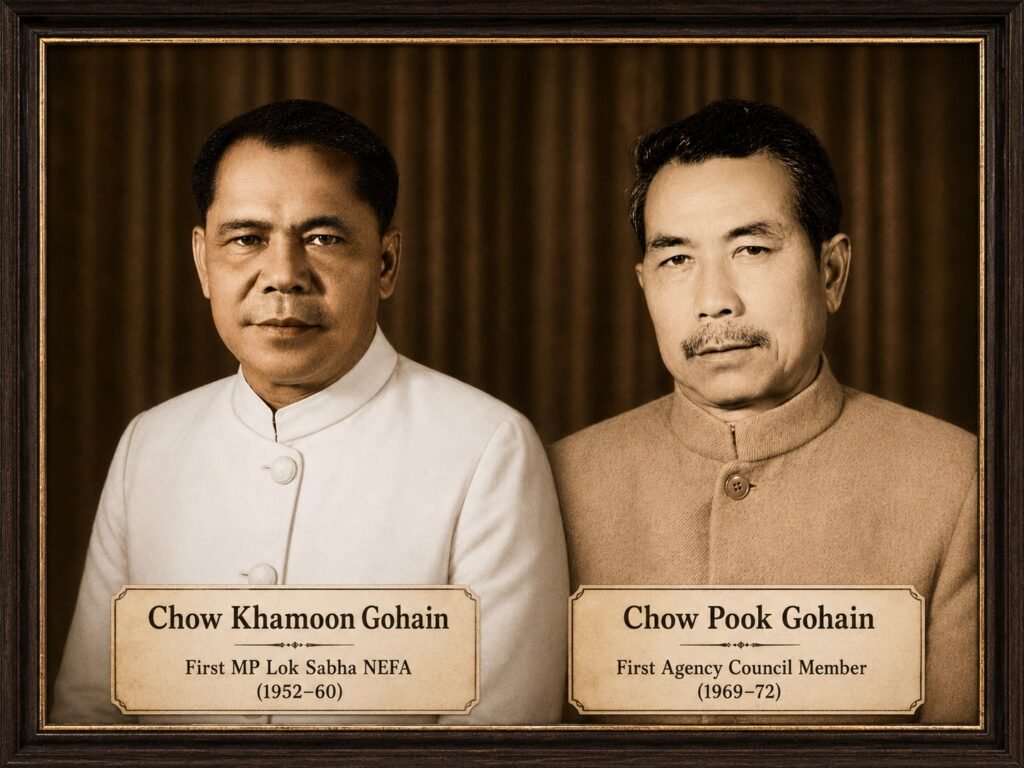
Historians say “Gohain” was never a clan name to begin with, it was the designation attached to the office of Tai Khamti Sadiya Khowa Gohain, an administrative post that is dated to the Ahom period. Given the prestige of the office, Tai Khamtis across all clans adopted the title as a mark of distinction. However, in the 1960s, Chow Khamoon Gohain, the then Tai Khamti Chief and President of the Tai Khamti Singpho Council, urged the community to revert to their original clan surnames instead of using the honorific title “Gohain.” His son adopted the clan surname and wrote his name as Chow Rajingda Namshum, while his brother, Indrajit Namchoom, reverted to the original clan surname by discontinuing the use of the title “Gohain” (Nani Bath, 2022).
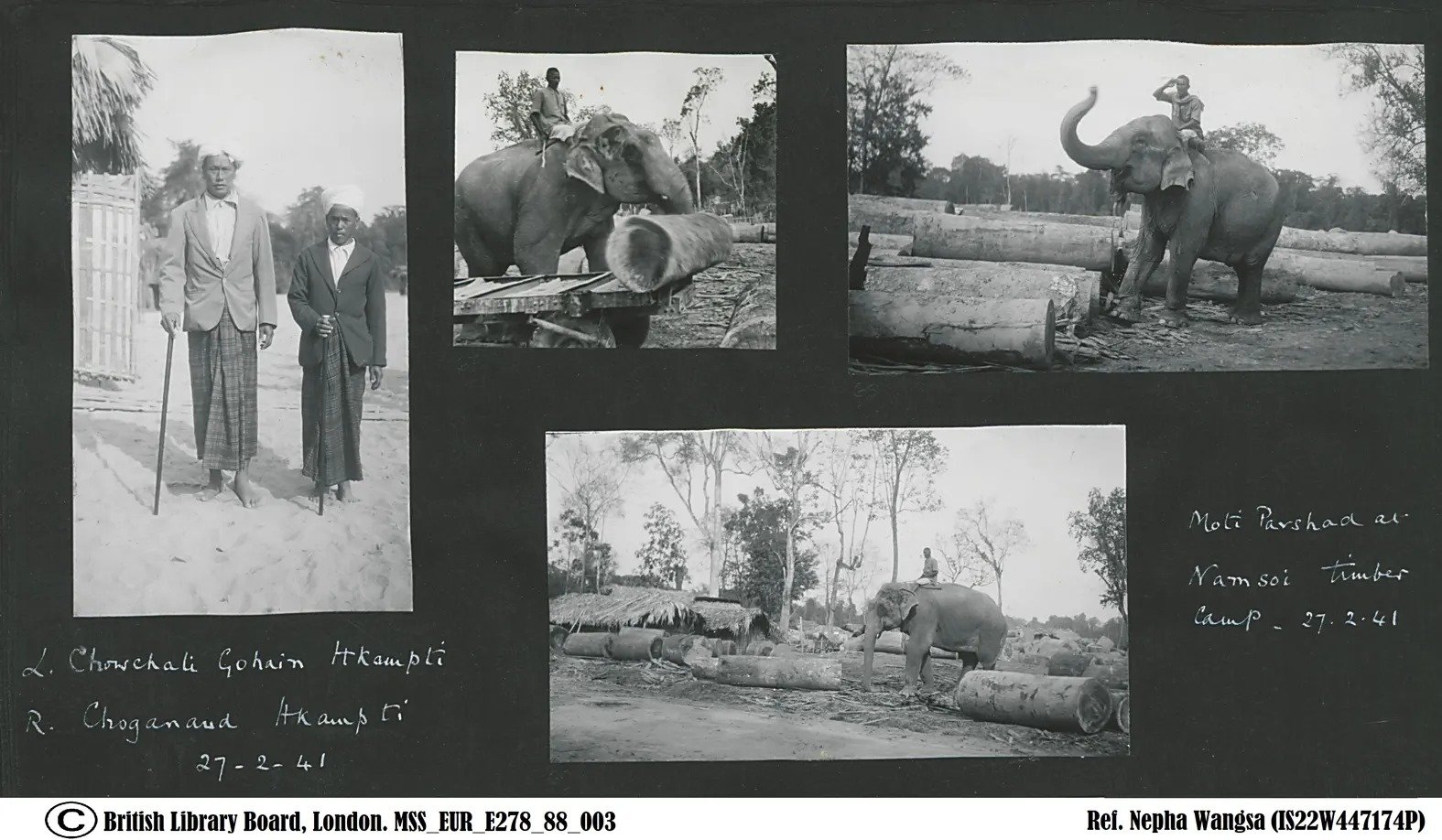
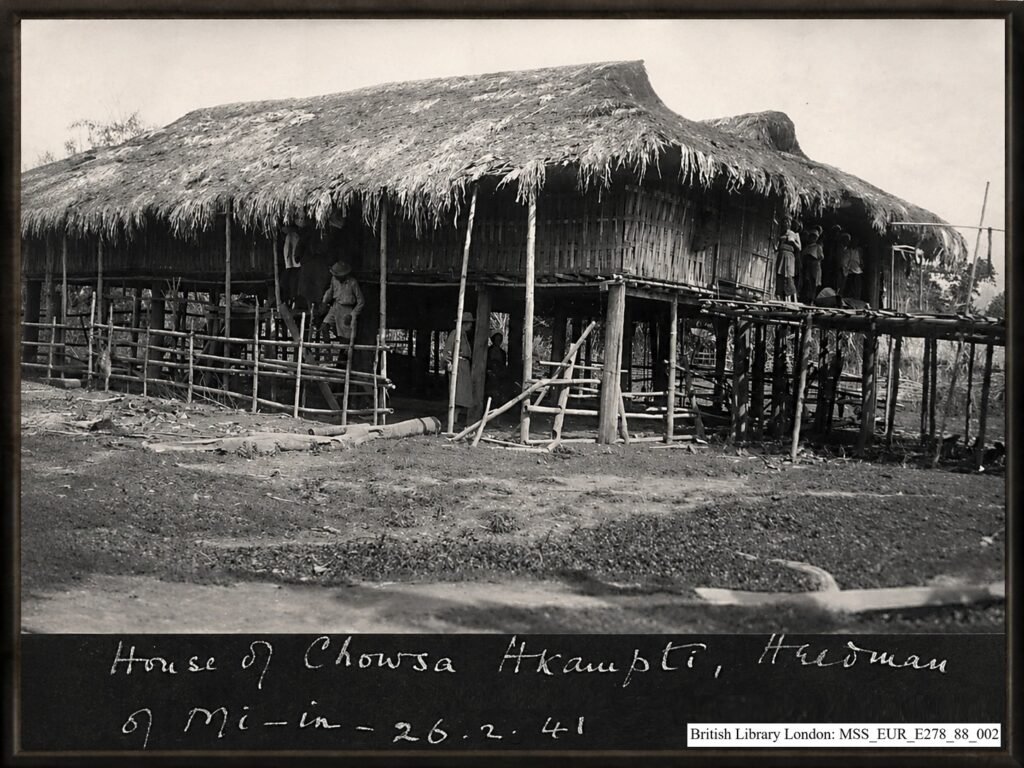
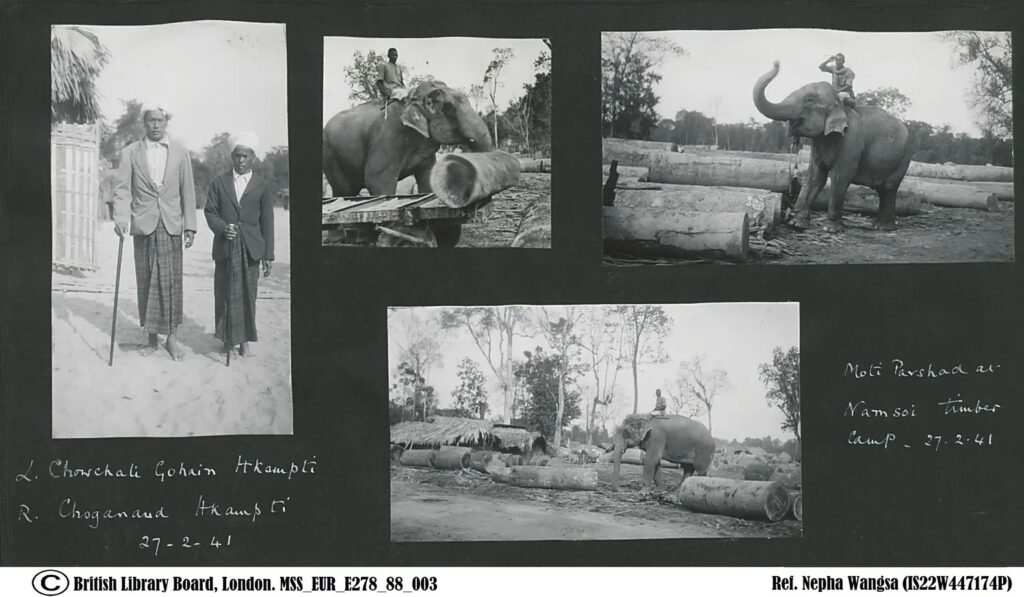
Beyond these questions, archival photographs preserved at the British Library, London, affirm the family’s place in history. Taken by the then Governor of Assam, Sir Robert Neil Reid, at the Namsai Timber Camp on 27 February 1941, depicts Chow Chali Gohain Khamti and Choganand Khamti, popularly known as Chow Kanan, along with an elephant named Moti and its mahout. The two men were the paternal and maternal grandfathers of Chowna Mein, and the photograph ranks among the rare archival record documenting a family from present-day Arunachal Pradesh. A second photograph taken on the same day shows the residence of Chowsa Khamti, the headman of Mi-in (Mein), which reflects the clan’s social and political prominence in the pre-Independence period.
The history of the title “Gohain” among the Tai Khamtis dates back to around 1794. According to A.C. Banerjee (1946), the Tai Khamti chief Chau-mu-ngan-lung, known as Deka Raja, became the first of the community’s leaders to hold the post of Sadiya Khowa Gohain during the reign of Ahom King Gaurinath Singha in 1793–94, after the Tai Khamtis established their authority over the Sadiya frontier.
When the British advanced into Upper Assam in 1824–25, they found Sadiya under Tai Khamti administration, and they formally recognised its authority. The Governor-General’s Agent David Scott acknowledged the Tai Khamtis’ position, and Captain Neufville subsequently conferred the title of Sadiya Khowa Gohain on the Tai Khamti chief Chausalan, authorising him to collect poll tax. An agreement signed by David Scott and Chausalan on 15 May 1826 remains as one of the strongest surviving records of British recognition of Tai Khamti authority in Sadiya according to historians.
Writing in ‘Topography of Assam’ (1837), John M’Cosh described that “Sadiya is the capital of the Kangti (Khamti) country” a record of the community’s political prominence in the early nineteenth century.
British surveyor W. Robinson in 1841 recorded that the Tai Khamtis, after their migration, first settled along the Tengapani river. A later report by Captain St John F. Michell (1883) documented the distribution of Tai Khamti and Singpho settlements before the 1839 uprising across the Tengapani, Noa Dihing, and Buri Dihing valleys. Among the Tai Khamti settlements were Jonorghat, Nairgaon, Sonkam (Chongkham), Palampan, and Kunungaon, while the Singpho settlements included Latao, Latolahgaon, Nepanpani, Nibluang, and Nidongaon. Mufing was identified as a mixed settlement. Michell estimated the combined population at over 5,000.
As the British gradually consolidated their authority on the frontier, suspicion of their intentions grew among the Tai Khamtis. Tai Khamti chief Chaupha Planglu began planning to expel the British from Sadiya. The opportunity came in January 1839, when Colonel Adam White summoned Planglu and other chiefs to a durbar to settle a dispute. On 28 January 1839, around 600 Tai Khamti warriors, joined by neighbouring tribes, launched a coordinated assault on the British post at Sadiya. Colonel White, the Gurkha regiment’s Subedar Major, and several others were killed, while the entire cantonment was set ablaze. Political Agent Captain F. Jenkins described the attack as “the boldest attempt yet made” against British authority on the frontier. It remains one of the earliest and most significant uprisings against the British rule in the North-East, nearly two decades before the First War of Indian Independence.
Following the 1839 uprising and the unrest that persisted until 1843, the Tai Khamtis were subjected to the same colonial strategy of “Divide and Rule” applied elsewhere in British India. In 1843, Captain Vetch scattered the Tai Khamti population across Sunpura, Tengapani, Demaji, Lakhimpur and Narayanpur in an effort to weaken their political and military influence. Despite this redistribution, most Tai Khamtis remained along the Tengapani River, where they had first settled after migrating into the region.
That dispersal explains the question often raised by the younger generation why Tai Khamtis are found today in both Arunachal Pradesh and neighbouring Assam. The answer lies in the archival records of 1843.
In independent India, the Tai Khamti community continued to contribute to Arunachal Pradesh’s constitutional and democratic evolution through leaders such as Chow Khamoon Gohain, the first nominated Member of Parliament from the North-East Frontier Agency (1952–1960), and Chow Chandret Gohain, who served as a Lok Sabha Member of Parliament from 1971 to 1977. Within the Mein family, Chow Pook Mein Gohain was among the first members of the Agency Council, while his son Chow Tewa Mein served as Pradesh Council Member and later as MLA. Chowna Mein and his wife, Nang Sati Mein, were elected as Members of the Arunachal Pradesh Legislative Assembly.
Chowna Mein was raised in Sunpura, in present-day Lohit district, and represents the latest generation in this distinguished lineage. His father, Chow Pook Mein Gohain, moved there from his native Chongkham village with his wife and three elder children to establish a sawmill in 1948, becoming one of the region’s first indigenous industrialists. It was in this entrepreneurial household that Chowna Mein was born and spent his formative years. He received his schooling at Don Bosco School, Guwahati, before graduating from Jawaharlal Nehru College, Pasighat, then affiliated with Gauhati University.
He entered electoral politics in 1995 with his election from the Lekang constituency to the Arunachal Pradesh Legislative Assembly. He subsequently served as Assembly Speaker, becoming one of the youngest to hold the office in the House’s history, followed by a long tenure as Cabinet Minister. Since 2016, he has serves as Deputy Chief Minister and is today the country’s longest-serving incumbent Deputy Chief Minister.
At a time when he has built a distinguished and uninterrupted political career, creating history in both Arunachal Pradesh and at the national level, and when his family has made significant contributions to the making and development of the State, questions over his identity appears least relevant. Such debates may generate momentary publicity, but history continues to speak for itself.
Moreover, how does one measure the legacy of one of the few families in Arunachal Pradesh whose history is preserved in the archives of the British Library, London? The Mein family’s lineage is also recorded in Chattue (chronicles) written in Lik Tai, the indigenous script of the Tai Khamtis. Together, these archival records stand as enduring testimony to a legacy preserved not only through oral tradition but also through authenticated historical documentation.
The evolution of the title “Gohain” is far more than a question of nomenclature. It reflects the historical interaction between the Ahom Kingdom, the Tai Khamti chiefdom, the British frontier administration, and the constitutional evolution of Arunachal Pradesh. While the title represented an important historical office, later generations revived ancestral clan surnames such as Mein, Namshum or Namchoom, and others, reaffirming their original Tai Khamti identity while preserving the legacy of the office once held by their forebears.
(The article is written by Fantry Mein Jaswal, IRS (Retd), former Chairperson, Arunachal Pradesh State Finance Commission, and sister of Chowna Mein, Deputy Chief Minister, Arunachal Pradesh, and Nepha Wangsa, Researcher, Unsung Heroes of Arunachal Pradesh, and currently serves as APRO to DCM. He can be contacted at nephawangsa@gmail.com)